On Nazareth Hassan
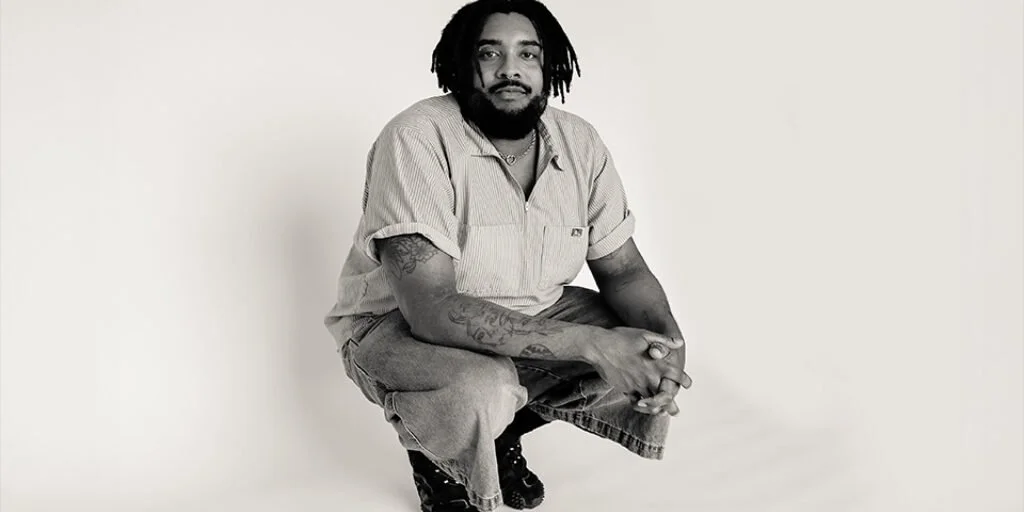
“I think in theatre I write a lot about shame—my shame, or things that you’re not supposed to say out loud, or that we’re not supposed to do in public for whatever reason. So it can be looked at and put out in the open, and we can experience it together.” - Nazareth Hassan
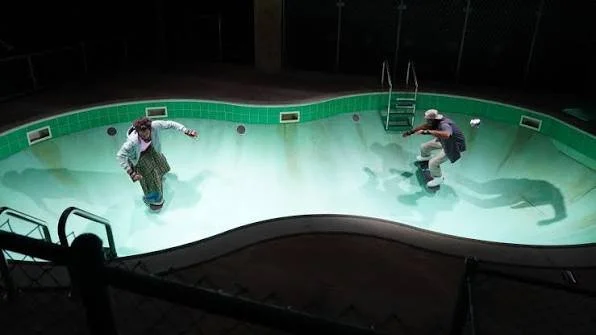
Skating and rapping and skating. Sex, Eating, Exercising Demons. Skating, rapping, naming, and skating. These are the rhythms felt in Nazareth Hassan's innovative play Bowl Ep which played a heavily extended run at the Vineyard Theatre last summer. The New York summer theater seasons can be somewhere stranded in a wasteland. At times it can feel like every well in the city has dried up, Joseph Papp’s Public is nowhere to be found outside of their summer Shakespeare programming, occasionally a show or two floats through but the line up feels largely unpopulated compared to the winter, spring, and fall. However, the Summer of 2025 proved me wrong, providing a carnival of exciting and invigorating new theatrical experiences. A highlight being Nazareth Hassan’s Bowl EP which had caught my attention with its exciting scenic and video design. A queer love story between two skaters trying to create a name for their rap duo? Sign me up! However, if I’m being honest, I truly had no idea what to expect. Reviews ranged from absolute raves to critical condemnations. In fact, when I had expressed interest in seeing the show to a fellow audience member of “The Last Five Years” she pleaded for me to “stay as far away from that show as possible”. Naturally, that only made me more curious as to what sort of theatrical madness was being hosted at the Vineyard Theatre. About a week later, I had grabbed 20$ rush tickets and was about to witness a play that would revitalize what I thought of as contemporary drama, all thanks to the ingenious mind of Nazareth Hassan.
“Playwright feels like too small a word to describe Nazareth Hassan.”- Xiomara Bovell
Nazareth Hassan is a Playwright, and a Musician, and a Performer, and a Poet, and likely many other things whose description may exhaust the length of this blog. Originally from Atlanta, Nazareth quickly moved to pursue an undergraduate degree in drama at NYU where they would concentrate on directing. Fellow student Marissa Joyce Stamps remarks on encountering them during their time at NYU, “When I was a first-year student at Playwrights Horizons Theater School, Nazareth Hassan was a senior there, putting up their talk-of-the-town thesis production of their play, Vantablack (2018). I said, Who is this dope Black playwright? I want to be like them! I struck up the courage to ask them to dinner at the highly esteemed Weinstein Dining Hall at New York University. We hit it off, and in that moment, Naz felt like an older sibling in a very white NYU Tisch, giving me advice and affirming my artistic practice.” After their time at NYU, they would go on to pursue their MFA in playwriting at Brooklyn College, where they would write the first draft of a play called Bowl EP. Even with their extensive theatrical training, they never lost touch with their passion for music & dance, allowing their musical inclinations & practice to influence their perspective on theatrical performance. Nazareth is not concerned with the traditional ways of being a playwright, which is evident in their work often being more concerned with tempo, rest, rhythm, and rhyme than a western idea of plot and narrative. However even in this, their work stretches through many genres, with their latest play Practice being described as a hyper-naturalistic piece. On the topic of realism in the theater, Nazareth remarks, “There is something really exciting about mimesis and attempting to replicate something that can’t be replicated. There’s something really exciting about that act—but it has to be seen as an act and not as a given. In the same way that going on stage and, you know, doing a five, six, seven, eight is also an act.”
So if Nazareth is so versatile, how would one describe their style? While Nazareth is certainly flexible, there is something in the soul of their work that is entirely singular. Style is a tricky thing, as it is often mistaken to be a static object, an easy assignment that begins to confine an artist without fully understanding the breadth and utility of their particular craft. Style is an evolutionary thing, only truly comprehensible post-mortem. An artist is a living thing not an object. However, what might be illuminating is to discover what has and is currently interesting Nazareth in their past, current, and future work. Through looking through their two available pieces, we can begin to develop the picture of who this radical contemporary playwright is.
“I’ve always thought about plays as the poetry of time and space in the body—and those three things sort of co-mingling in a certain way.”- Nazareth Hassan.
Untitled. (1-5)
Immediately Untitled (1-5) gives a strong impression of Nazareth's musical background as it is self described as a score for performance of language rather than a theatrical script. In their essay about the piece Nazareth muses on the hidden strength of the invisible. They reflect on the ways in which our society can value those who wish to be the center of attention. This is not a product of narcissism, as to be visible requires a certain adrenaline in order to represent the outnumbered individual. The adrenaline becomes a respected quality of what Nazareth has deemed “The Star”. However, Nazareth asks in their thesis that the invisible be treated with the same respect we grant The Star. Invisibility to Nazareth means “refusing to define oneself by the given hierarchy of power”. Invisibility is wanting existence “without the mirror that has been placed behind my eyes”. Nazareth concludes that all people & peoples contain this mirror, but marginalized communities become aware of it much earlier. Perhaps the title or lack thereof of the performance score to follow is reflective of Nazareth's desire to live outside of definitions of power and assertions of identity & behavior.
The score consists of 6 “blk” performers of any age dressed identically neutral. The space is also defined as neutral with the only description being 6 mics. Nazareth's notes on the score emphasize the need for musicality and rhythm in performance, describing it ultimately as a trance for both actor and audience. This highlights Nazareth’s deep understanding of theater’s inherently complicit nature between audience and actor. The score is separated into 5 distinct sections, seemingly representing the (1-5) moniker in the title, which are as follows: “On the Body”, “On Joy”, “On Gratitude”, “On Failure", and “On Faith”.
“On Faith” begins with a plunge into darkness. Immediately we begin to understand that this experience will be deeply sensorial as the sounds of the body in action fill the space. Nazareth then begins to break the conventions of the physical space by implementing sounds of thought, sounds of disjointment, sounds of holding, etc etc. Nazareth exemplifies an understanding that the playtext or musical score has often been treated as the holy text which can place the playwright at the top of the hierarchy with the director being a sort of holy appointed monarch of the physical space. In Nazareth’s score, it becomes impossible for anyone besides the direct participants to create the immaterial in the physical world. By giving the seemingly “impossible task” of encapsulating these abstract ideas into sound, Nazareth illustrates the way in which any action written for the stage is an impossible task of sorts. “On Joy” works to explore the different manifestations of a key expression of Joy: “A Laugh”. Sometimes together, sometimes in silence, sometimes working with each other in a poetic counterpoint. Nazareth completes the joyous symphony with the questions of how people keep time in their bodies and the what, where, when and why of how they use it. This appears as almost a commentary on the way in which an unrestrained explosion inherent to the laugh is put into the contained score with clearly delineated lines for each actor. In fact this is the only section of the piece that will clearly delineate which actor gets what line. Perhaps “On Joy” is asking about the container put on joy by ourselves or others in many ways reflecting the ideas of the internal mirror mentioned in the earlier essay. “On Gratitude” features an element of Nazareth Hassan’s writing expertise that would later appear in Bowl EP. That is their ability to permeate language, and have language exist in a state of evolutionary flow. Much like Quentavius and Kelly’s iterations on their rap group name in Bowl EP, the actors in Untitled. (1-5) create music using the phrase “if it ain’t broke don’t fix it”. This phrase of gratitude becomes a phrase of apathy, of oppression, and importantly of a cycle of repression coming from a black parental figure to a black child. “On Gratitude” has us explore the cycle in which gratitude can become a tool of white complacent indoctrination that can become perpetuated by communities of color themselves. The fourth section “On Failure" continues this play with language evolution by iterating on the phrase “I’ve Failed At _____”. Throughout the sequence, the actors speak, in unison, in different ways they feel they’ve felt the societal and cultural expectations placed onto them. Radically however, they also speak on the way that they’ve failed to claim their failure as a radical act. During the text, the actors play out different scenes of shame and being the self in the physical space. All of this highlights further Nazareth’s idea of the mirror , there is no place “to be” in contemporary society, one either has to exist in the definition provided by the social order or in stark subversion to the social order. In having the text and physical exist in the same space, Nazareth asks us when, if ever, we allow bodies, specifically black bodies, to exist outside of the hierarchical context that they exist within. The last section “On Faith” consists only of a series of outlined walking patterns, meant to be depicted in a slow and steady pace. Perhaps this scene is the answer to Nazareth's questions in the mirror. We are for a moment, given the opportunity to see bodies, purely in motion. Without the framing of paralinguistics, sound, darkness, or text. The audience observes the crop circle like movement of black bodies, not made to be anything else but existing.
Untitled (1-5) is a strong indication that Nazareth hopes to push the form beyond the restrictions of contemporary commercial theater, inviting their audience to confront the ways in which their existence and shame exists outside of the framing in hierarchies of white supremacy.
Bowl EP
Bowl EP starts with almost 2 pages of entirely dialogueness skating & smoking. A feeling that can truly only be understood on the stage as the two actors immediately infuse the chemistry that will carry the rest of the play with it. If Untitled (1-5) wasn’t an indication of Nazareth's intricate understanding of the script as a score for the physical, it’s certainly apparent here. What follows is a seemingly innocuous conversation about coming up with a new lyric for their EP:
“Get high to see far, you don’t know who we are
We’ll nut upon ya face and call it street art”
The seemingly bare content of this scene drew out cries of laughter from the audience that would only intensify as the play continued. This is not out of mockery, but rather out of relatability for all the somewhat silly conversations one has with a friend while smoking. The second scene, titled “Track 2 is picking a name for their rap group attempt one” immediately starts with our two lovers, Kelly & Quentavius, going back and forth creating a litany of possible group names ranging from “Raw octopus in my pussy” to “drag ur dads dead drunk dad bod down the bad dang stairs”. Within the first two scenes, Nazareth has already brought in that which to some may seem entirely sacrilege to the theater but to our audience felt entirely hyper real. Conversations that to some might seem inherently untheatrical became a deep subtextual poetry and the air filled with Kelly & Quentavius’s intimate world. Paired with this intimate relationship is the framing of each scene with its track name. Sometimes repeating titles to recontextualize them or create an evolution of a dynamic throughout time. On page 18 we get introduced to Chekhov's gun of Bowl EP, Quentavius’s demon Lemon Pepper Wings. Quentavius remarks on the deep shame personified by their demon and how vicious they/she/he can be. If you thought we would go on without an appearance from Lemon Pepper Wings, you would be sorely mistaken. After more tracks of skating, doing drugs, eating, irrotic acts, and naming their rap group, Kelly makes Quentavius gag up their demon, Lemon Pepper Wings. Suddenly the container of the play is shattered by the power of Lemon Pepper Wings who directly addresses the audience having Kelly & Quentavius put on a 4 song concert for the audience that ends in a duet between the couple and a rampaging Lemon Pepper Wings who goes on to take over the rest of the show, describing in a prolonged monologue how the couple's relationship/breakup unfolds in the coming years. Following the monologue are three scenes featuring a slowly disintegrating relationship between the lovers, as with the reveal of Quentavius’s shame, he retreats from the intimacy they once shared, eventually suggesting that they take up the name “The Rappers” as its a low stakes commitment.
When I had originally seen Bowl EP, I had been completely jarred by its abrupt transition into the forth wall breaking exorcism it becomes. However, by the end of the play, I found myself sobbing at the profound encapsulation of love in the age of internet aestheticism. The play parallels the ways in which in our day in age, we are consumed with the idea of something opposed to the reality of it. Reality hurts, Image is a static thing. In a way that is paralleled through the form. By having Lemon Pepper Wings verbally describe the unfolding of the plot it gives the audience the thing we expect to want, Plot, but without any of the soul and substance of the character and relationship. In a way that almost parallels Thorton Wilder’s Our Town, we become acutely aware of the thing we had taken for granted: the quiet moments, the passionate back and forth about increasingly ridiculous Rap Group names, the uncovered shames, and “indecent” acts of queer love. As someone who often feels like they need to be moving at 100 miles an hour, the radical presence in BOWL EP was not only deeply intellectually understood but, more importantly, profoundly felt.
On depicting Black stories in the American Theater, Nazareth explained “Audiences are coming into Black work subconsciously expecting some form of minstrelsy to confirm their ideas about Blackness.” Nazareth is constantly aiming to challenge the ideas of blackness perpetuated in art and society, and in Bowl EP they tackle how Black Queer Americans not only tackle the weight of their identities but engage with a world that demands a constant presentation of the self to distance itself from the experience of being alive.
Future Work
What happens next for Nazareth Hassan? Their play Practice is currently playing a run at Playwrights Horizons, slated to close on December 19th. Similarly to Bowl EP, Practice has received rave reviews from many prominent figures in the New York City theater community. Practice is described as a play about a cult emerging from a narcissistic theater director who stops at nothing to bend the will of the artists serving his theatrical vision. After Practice, Nazareth is debuting their new play Kat at Theater 503 in March of 2027. This play is slated to be an exploration of furries, religion, and all things transhuman. One can see that Nazareth’s work is only on a meteoric rise, and I hope that Nazareth Hassan can be regarded as one of the leading figures in their cohort of contemporary playwrights alongside the likes of Branden Jacobs Jenkins, Tarell Alvin-McCraney, and Annie Baker. Their radical theatrical challenges serve as a strong piercing stab into the stagnant overly commercialized environment of contemporary theater. As history has often proved, economic and political hardship is exactly the time when art needs to be radical to sustain its power to meaningfully affect the world and expose our inner shame.
Sources
So Tender, So Fragile – Culturebot
Nazareth Hassan by Marissa Joyce Stamps
Bowl EP by Nazareth Hassan
Untitled (1-5) by Nazareth Hassan